
The Routing Race: Why Apple’s AI Moat is Built in Silicon, Not Software
We tell ourselves a simple, comforting story about Apple’s dominance. We call it the "walled garden." The narrative goes like this: we buy an iPhone, we get hooked on the seamless blue bubbles of iMessage, we store our lives in iCloud, and the psychological and digital friction of leaving simply becomes too high. It is a story of consumer entrapment.
But what if that narrative gets the equation entirely backward? What if the ecosystem isn’t the trap, but merely the economic exhaust of a much deeper kind of dominance?
To understand Apple’s true advantage in the impending age of artificial intelligence, you have to look past the app ecosystem and look at the basics. Apple’s moat is simple: it controls the hardware, the operating system, and the infrastructure that decide exactly where AI runs. As the battleground for consumer AI shifts from cloud-hosted chatbots to ambient, edge computing, Apple relies on an advantage that competitors cannot simply code their way across.
Monopolizing the Physics
Artificial intelligence, particularly when it runs on a device in your pocket, is heavily constrained by heat and memory. You cannot solve these constraints purely with clever software; you have to solve them in the silicon. Apple monopolizes these physical constraints for one specific reason: to control exactly where the work happens.
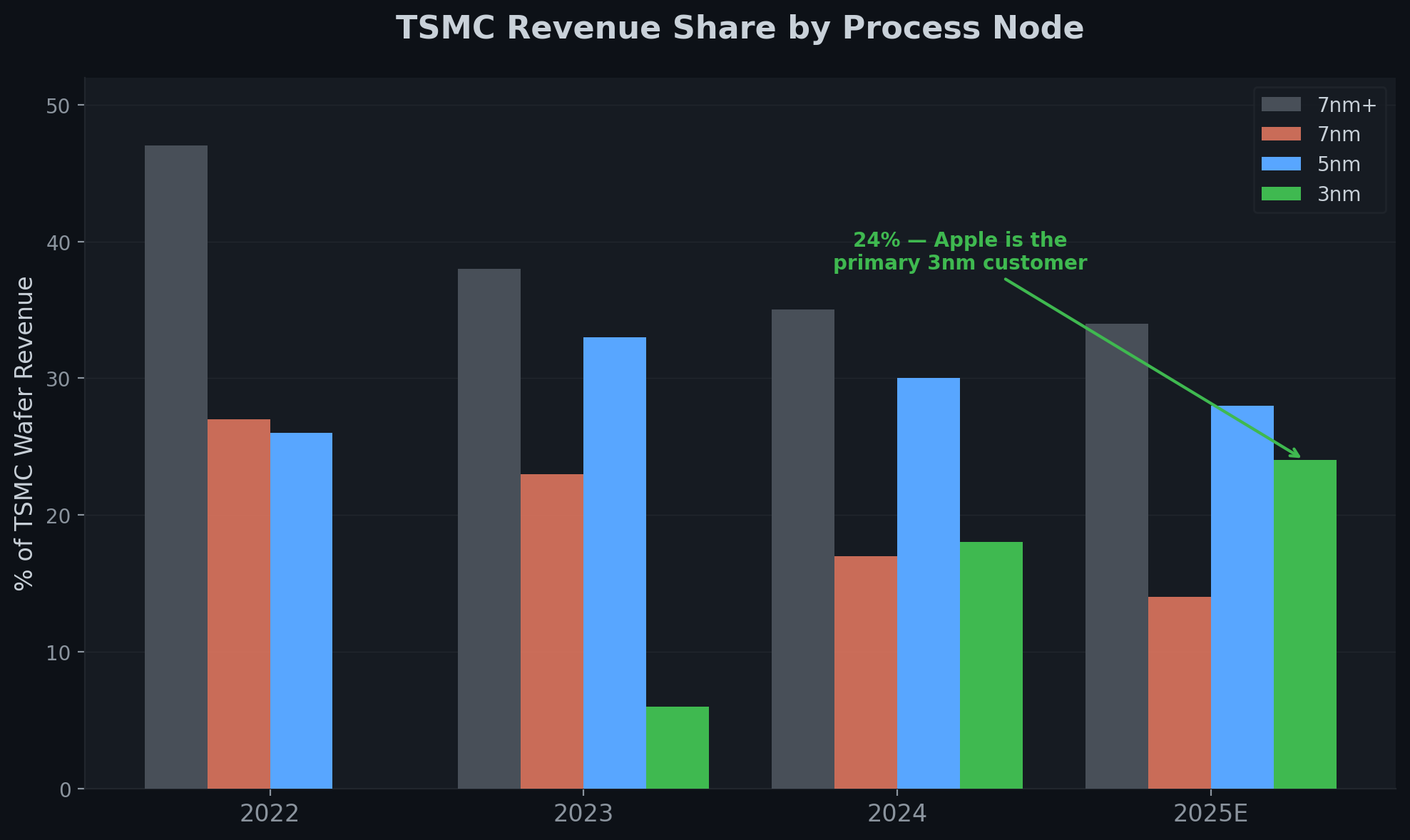
This is where Apple’s supply chain stops being a logistics story and starts becoming a control story. Apple uses its massive scale to absorb the financial risk of transitioning to new manufacturing nodes before the rest of the industry. They are consistently the primary customer for Taiwan Semiconductor Manufacturing Company’s (TSMC) most advanced processes; in 2025, TSMC's 3nm node already accounted for 24% of its wafer revenue.
But AI workloads are notoriously memory-bound. It doesn't matter how fast your processor thinks if it cannot load the data fast enough. Apple secures the microscopic pipelines that fuse silicon and high-bandwidth memory together, operating as the anchor customer of Amkor's advanced Arizona packaging site.
By locking down this upstream capacity, Apple ensures that devices equipped with the A18 Pro or the M5 chip can execute complex models locally without throttling. Economically, this changes the game: it allows Apple to ship advanced AI features as baseline product defaults, rather than taxing their margins with costly, continuous cloud inference. Android OEMs may have massive global scale, but they remain dependent on third parties for their silicon and platform layers. Apple designs the entire solution, ensuring the hardware is tuned exactly to the workload the software creates.
The Gatekeeper
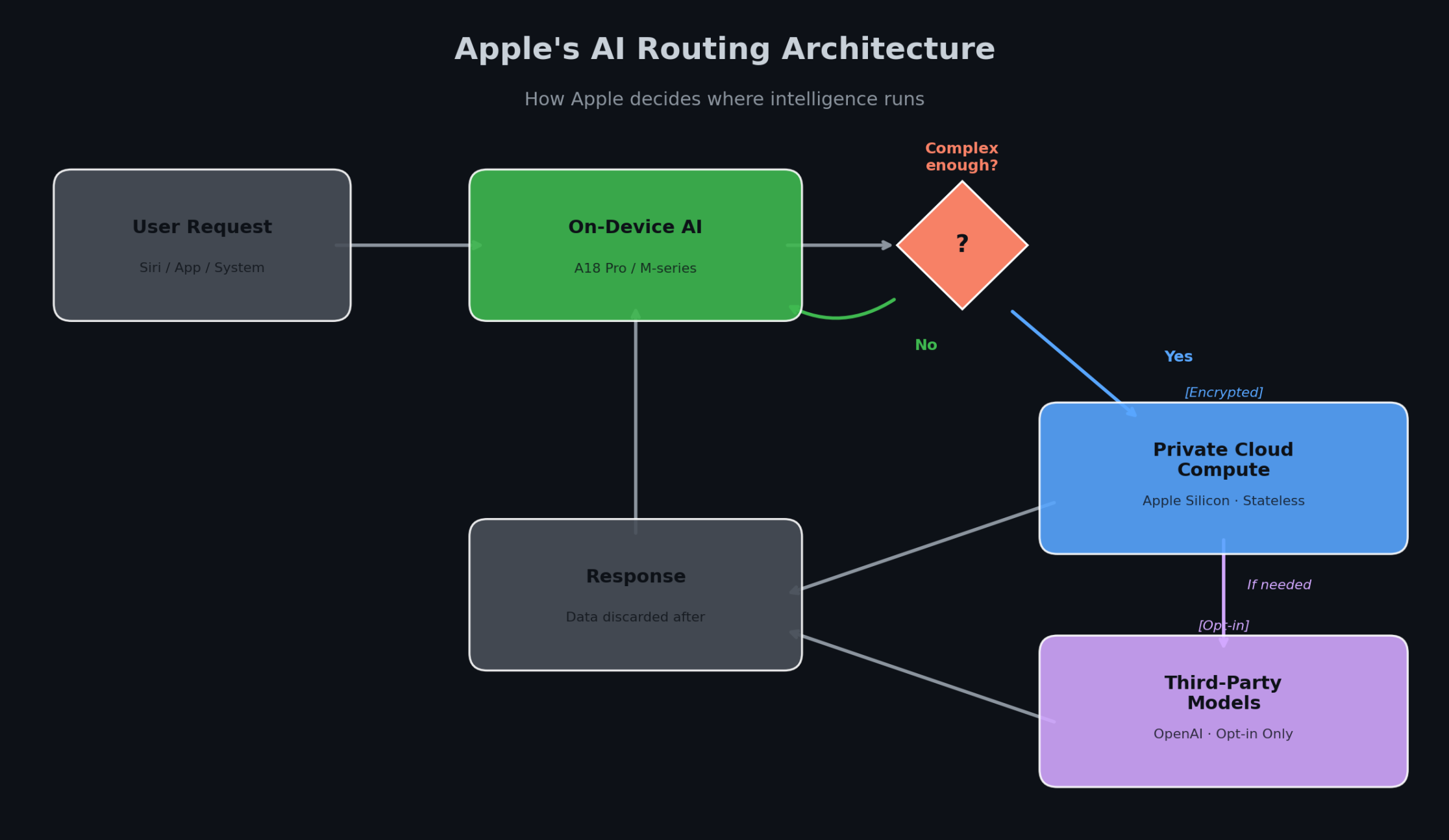
If you understand that Apple's advantage is physical control, you understand why their approach to the cloud is fundamentally different from the rest of the industry. The defining feature of Apple’s AI is not just that it processes data on the device; it is how it routes the work when the device is no longer enough.
When a request is too complex for the iPhone, Apple does not send it to a standard cloud server. It routes it to Private Cloud Compute (PCC).
PCC is the core of Apple’s AI strategy. It is an infrastructure built with custom Apple silicon and a hardened operating system, utilizing "stateless computation". This means user data is used exclusively to fulfill the request and is immediately discarded. Apple even publishes the expected measurements of the PCC software to a public transparency log for independent verification.
PCC is not just a privacy feature. It is the gatekeeper. It allows Apple to treat compute as a tightly managed resource, dictating exactly where intelligence lives, where it travels, and when it dies. Apple doesn't need to win the frontier model race if it owns the router that decides which model gets to answer your query.
Routing to the Body
This routing logic extends outward to the user's body. The defining AI experiences of the next decade will likely not be won by typing into a phone screen. Apple is positioning its peripherals not as accessories, but as the primary tools for everyday AI.
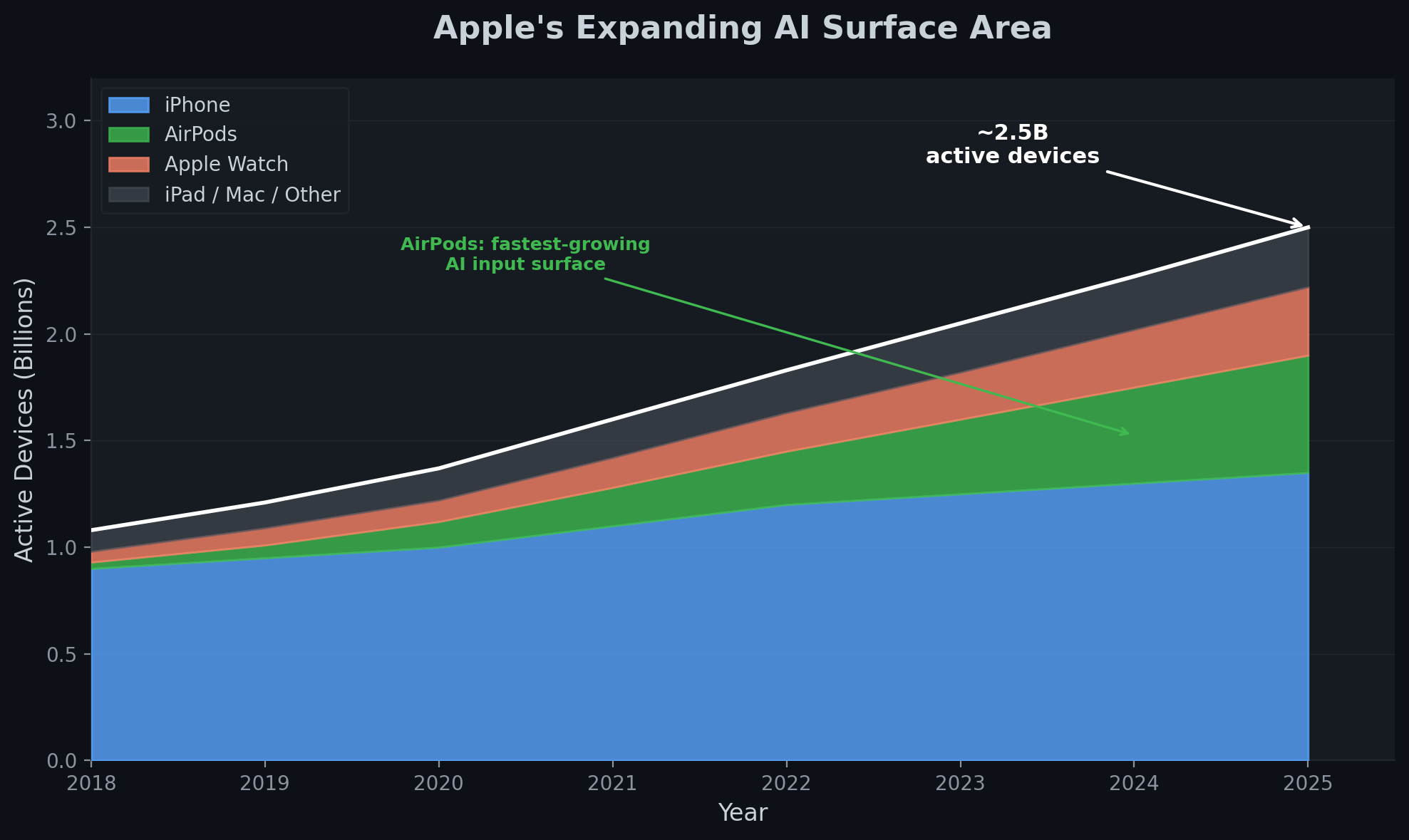
The iPhone remains the identity and compute hub, but the interface migrates. AirPods offer continuous wear and frictionless, private voice interaction. The Apple Watch provides a high-trust, body-worn sensor platform for biometrics. These endpoints matter because they solve the input bottleneck; they provide the constant, low-friction context and always-available biometric trust that a screen-bound assistant simply cannot capture. The strategic goal is not to build a better chatbot, but to flawlessly route intelligence into the ear and onto the wrist, demanding far less behavioral change than interacting with smart glasses or separate AI devices.
The Knife Fight and the Concrete Tradeoff
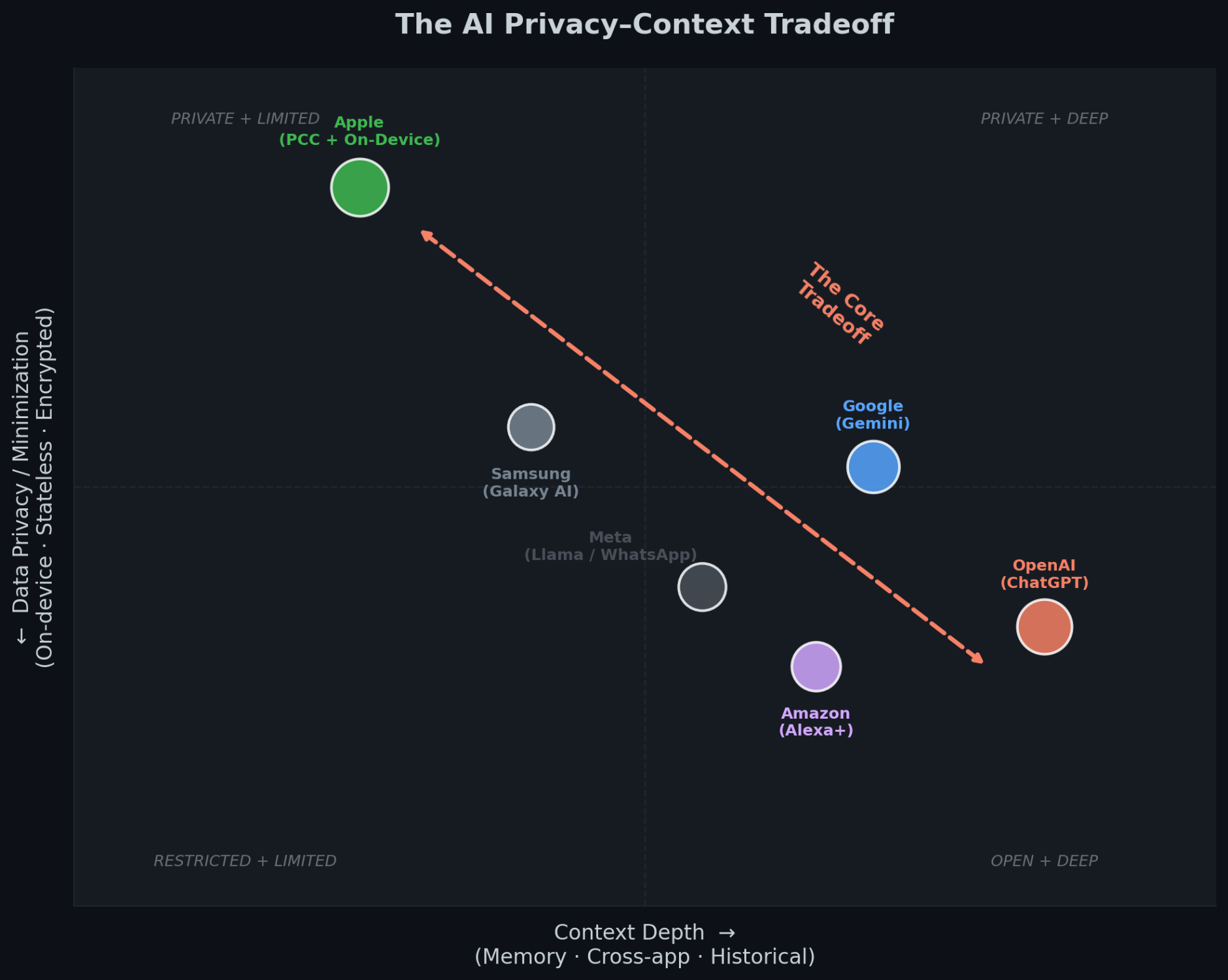
Despite this physical advantage, Apple faces a massive test. The true competitive conflict in consumer AI is not a list of tech giants fighting for market share. It is a direct conflict between two models: Apple’s bounded, physical, on-device context versus the market’s push for cloud-native, persistent memory.
This is Apple's concrete product-market risk. OpenAI and Amazon are explicitly training their models to build deep, historical context. Remembering past conversations, analyzing uploaded documents, and synthesizing a user's entire digital history to act as an all-knowing assistant. This alternative is undeniably compelling; it offers true cross-context delegation, creating an assistant that anticipates needs based on a seamless, unbroken memory of your habits and workflows. Apple’s PCC architecture, with its strict data minimization and stateless computation, expressly forbids this kind of long-term retention.
If consumers ultimately decide that the utility of an AI that remembers everything about them outweighs the desire for perfect data privacy, Apple’s architecture ceases to be a protective moat and becomes a functional cage. They will have to choose between maintaining their strict routing rules and matching the deeply personal utility users find elsewhere.
The Fork in the Road
In the near term, Apple’s position is highly secure. They will remain a premium device company, utilizing a deeper AI layer to improve peripheral attachment and monetize an installed base of 2.5 billion users.
But over the next decade, the routing race forces a strategic fork.
If AI standardizes around model APIs and infinite cloud memory (services that float agnostically above whatever hardware you happen to be holding) Apple’s advantage narrows. They will still sell excellent phones, but the value will shift upward to the cloud companies running the models.
However, if consumer AI demands tight latency, biometric trust, and physical integration. An intelligence that must seamlessly route between our ears, our wrists, and the silicon in our pockets. Then Apple is uniquely positioned. They are the only company that controls the entire physical stack. If the future requires that level of integration, Apple owns the gate.