The Real AI Bottleneck Is Not Compute. It’s Electrical Delivery
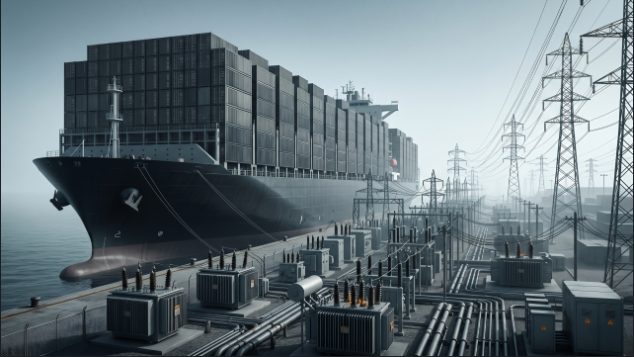
When supply chains seize up, people notice the container ships first. They are dramatic, visible, and easy to photograph. But the ships are rarely the true bottleneck. The real constraint usually sits onshore, in berths, cranes, truck appointments, rail links, warehouse space, and all the smaller handoffs where physical systems quietly fail under pressure.
AI infrastructure is beginning to look similar.
Data centers are the container ships of this moment: large, expensive, and impossible to ignore. But the real constraint is increasingly not the buildings themselves, or even the chips they contain. It is the electrical and thermal delivery system beneath them. The challenge is no longer just producing more compute in the abstract. It is delivering massive amounts of reliable power, cooling, and grid access to specific sites on timelines that collide with transformer shortages, transmission lead times, interconnection backlogs, and local utility realities.
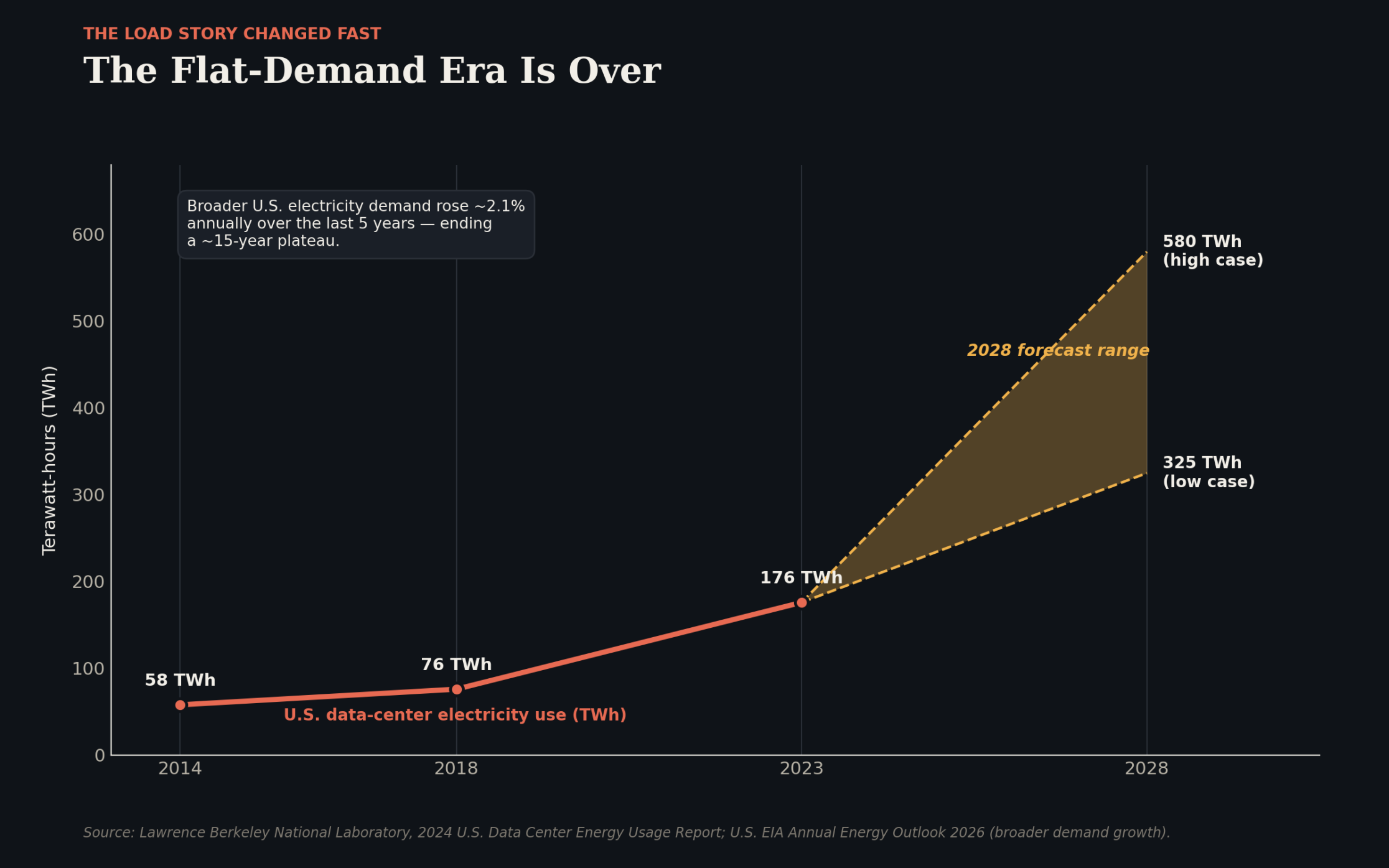
That shift matters because U.S. electricity demand is no longer behaving like it did in the flat years. After roughly fifteen years of little change, demand has turned upward again. Recent federal energy data shows electricity consumption has increased by about 2.1% per year over the last five years, with data center server energy use a major factor in the long-term outlook. In the nearer term, net load grew about 1.7% annually from 2020 to 2025, after averaging just 0.1% annual growth from 2005 to 2019. Large computing facilities are part of that story, but so is expanded industrial electricity use.
The data-center piece of the story is already big enough that nobody serious can wave it away. Berkeley Lab estimates U.S. data centers used 176 terawatt-hours of electricity in 2023, about 4.4% of total U.S. electricity consumption, and could reach roughly 325 to 580 terawatt-hours by 2028. That range is wide on purpose. It reflects uncertainty around server shipments, utilization, and cooling efficiency. But the broad message is unmistakable: this is no longer a speculative niche. It is a material load category moving fast.
Still, “data centers use a lot of power” is the dumbest possible version of the problem. Electricity is not an abstract commodity, and these are not ordinary commercial customers. Data center demand is growing rapidly, varies by region, can be constrained by latency requirements, and often requires firm power. Servers account for the majority of electricity use in modern data centers, while cooling can range from roughly 7% in efficient hyperscale sites to more than 30% in less-efficient enterprise facilities. Backup systems remain central because outage tolerance is effectively zero. In practice, then, a new AI facility is not simply requesting more megawatts. It is requesting power, cooling, backup, and power quality all at once.
That is why the most accurate framing for this moment is not that AI is “breaking the grid.” It is that AI is colliding with a broader industrial electrification cycle that was already gathering force. The rebound in electricity demand is tied not just to data centers, but also to manufacturing and wider electrification. This is what makes the story bigger than AI hype. Data centers are the sharpest visible accelerant, but they are arriving in a system already being asked to support more factories, more electrified end uses, and more new infrastructure at the same time.
The real strain shows up lower in the stack.
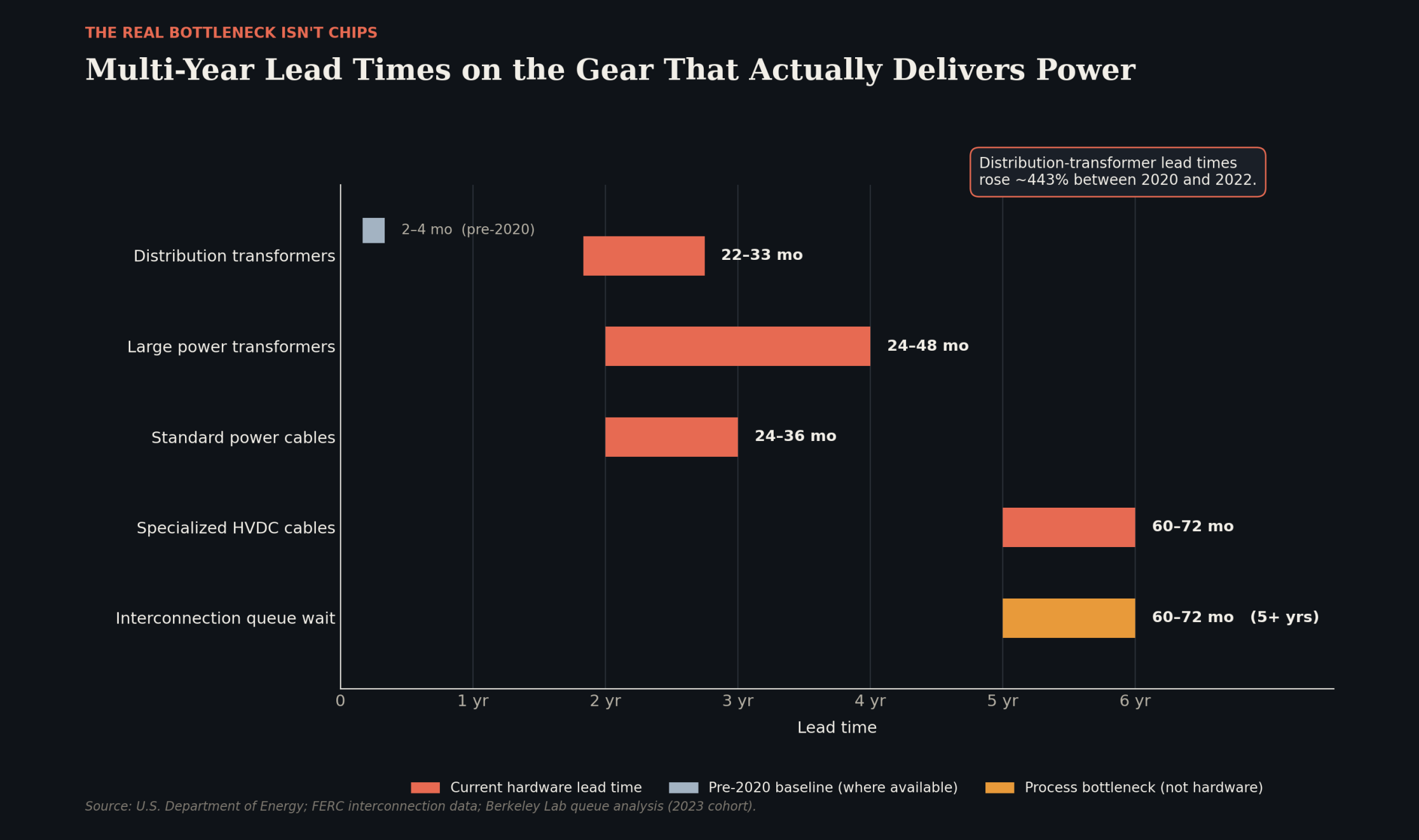
Distribution transformers have emerged as one of the power system’s most stubborn supply-chain constraints. Federal energy data shows average lead times rose 443% between 2020 and 2022, stretching what used to be two-to-four-month waits into 22-to-33-month waits. Transformers remain core building blocks of the grid facing long lead times and component shortages. These are not the kinds of bottlenecks that make for glamorous conference panels. They are the kinds that decide whether a project gets energized or sits around aging into irrelevance.
Interconnection is no less ugly. The queue backlog now exceeds 2,000 gigawatts, and wait times are longer than five years. Berkeley Lab’s queue work shows the median time from interconnection request to commercial operation reached five years for projects built in 2023. This is the sort of sentence that should make executives visibly uncomfortable, because it means the average project idea is moving at a pace wildly misaligned with the operating tempo of the industries now demanding power.
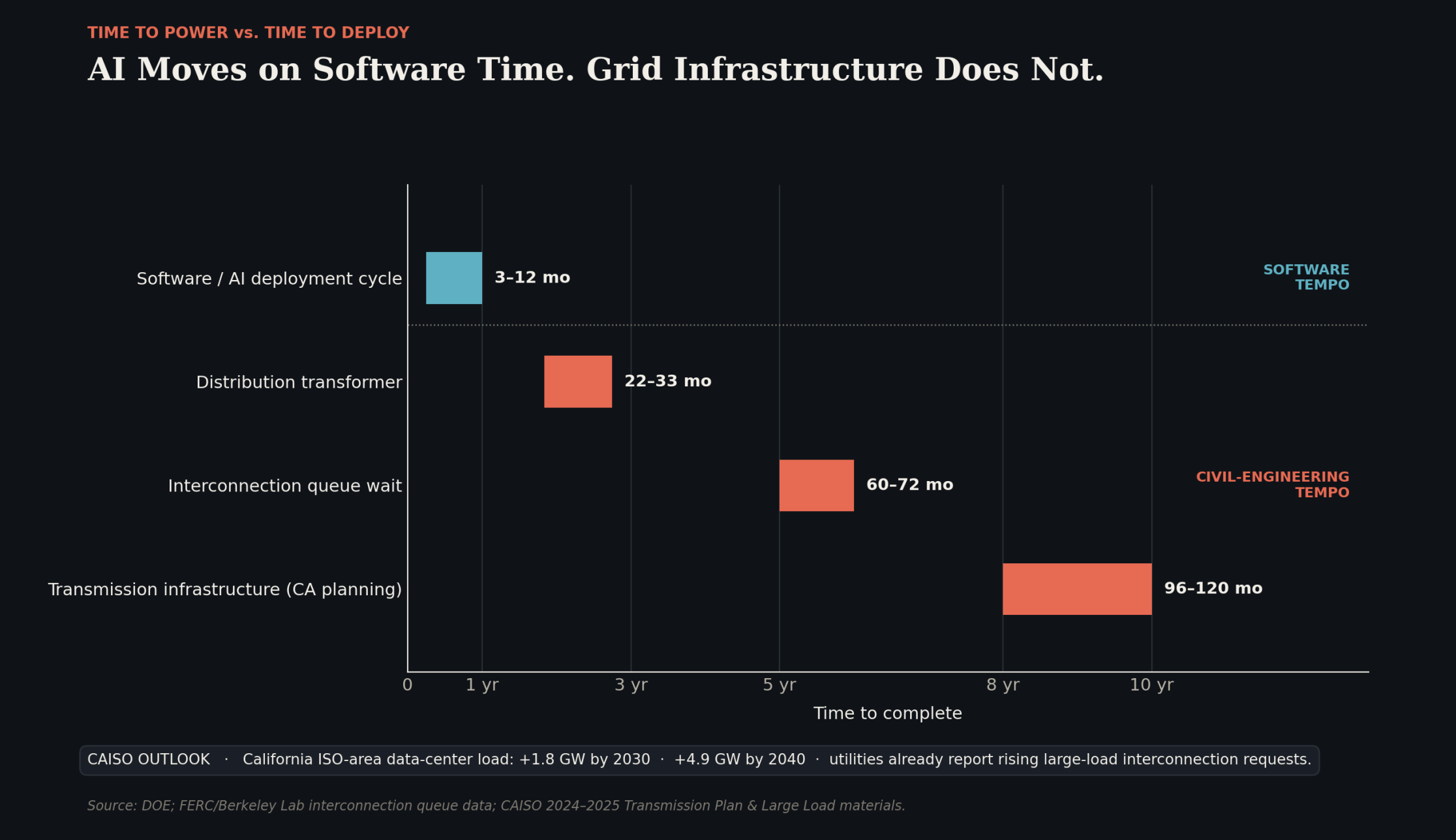
California is a useful stress test because it makes the timing mismatch impossible to hide. The California Energy Commission forecasts data-center load on the ISO grid rising by 1.8 gigawatts by 2030 and 4.9 gigawatts by 2040, while utilities are already seeing more large-load interconnection and service applications. At the same time, CAISO’s 2024-2025 transmission plan approved 31 new projects totaling $4.8 billion. Some of the needed infrastructure still moves on timelines measured in eight to ten years. Software demand is arriving on software clocks. Transmission still arrives on civil-engineering clocks. There is no clever product launch that changes that.
And even “load” is too simple a word for what these facilities do to the system. Large electronically controlled data-center loads can create voltage distortion, flicker, harmonics, and sub-second step changes in demand that affect local transmission conditions and power quality. UPS systems, backup generation, and associated equipment can also affect breaker-duty margins and protection coordination near substations. In other words, these facilities are not just large consumers of energy. They are technically demanding grid actors.
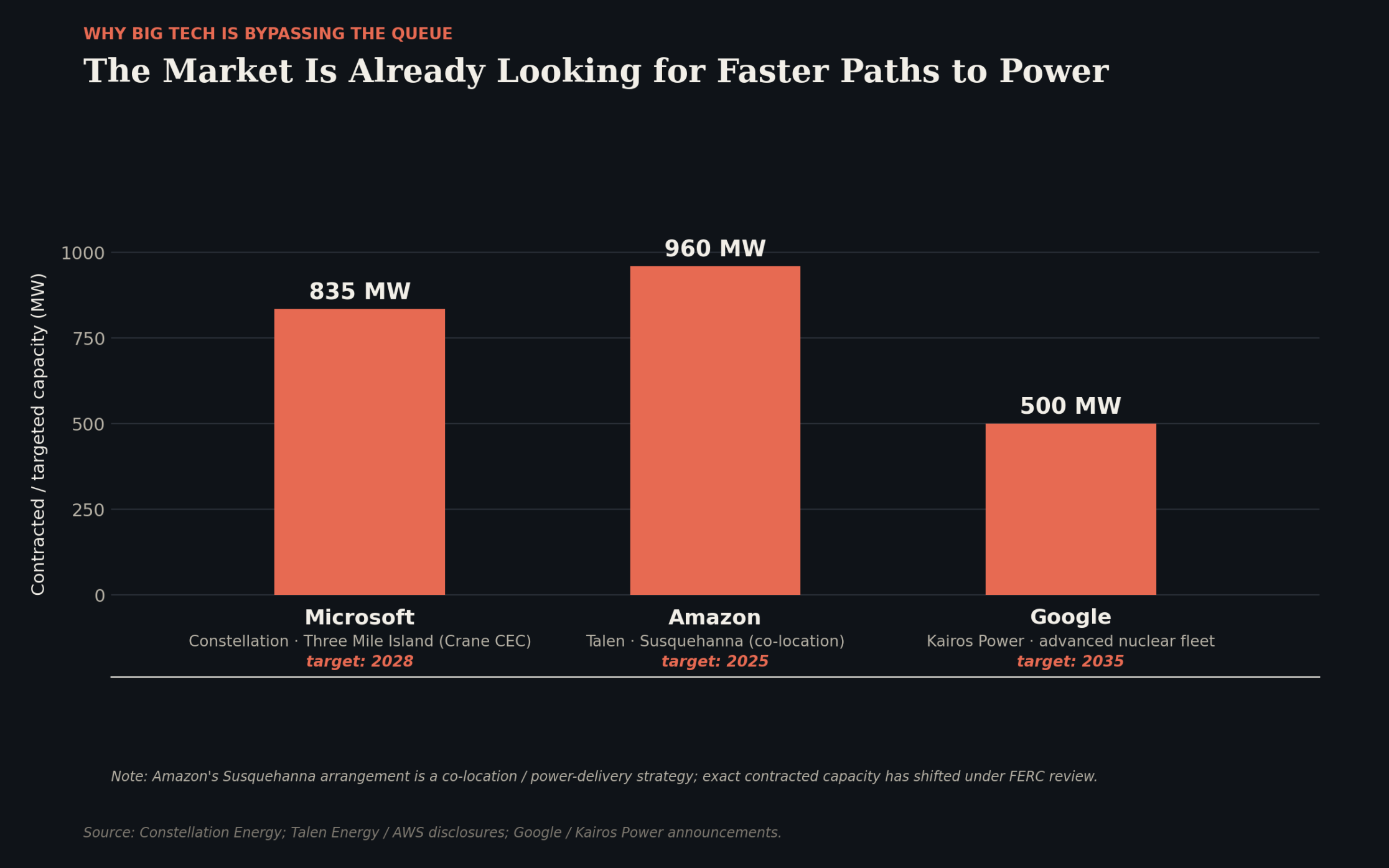
That is precisely why the market is already moving toward captive and semi-captive power arrangements. Microsoft backed the restart of Three Mile Island Unit 1, now the Crane Clean Energy Center, through a 20-year power purchase agreement intended to bring roughly 835 megawatts of carbon-free generation back online. Amazon signed an agreement to co-locate an AWS data-center campus next to Talen Energy’s Susquehanna nuclear facility in Pennsylvania, and that relationship later expanded to deliver grid power for additional Amazon operations in the state. Google, meanwhile, signed an agreement with Kairos Power to support a fleet of advanced nuclear projects totaling up to 500 megawatts by 2035. These are not symbolic sustainability gestures. They are strategic responses to a world in which waiting passively for the grid to sort itself out has started to look like a business risk.
Regulators can see where this is headed. Federal regulators have already launched action on co-location issues related to large loads such as AI-enabled data centers in PJM and later directed PJM to create clearer tariff rules for these arrangements. CAISO is running its own large-load initiative, including co-located generation and load. That matters because the next phase of the debate is no longer just about “more supply.” It is about who gets to bypass which parts of the delivery chain, on what terms, and who pays when those arrangements distort the rest of the system.
The sober view is still the right one. Not every announced project becomes real load. Not every queue position becomes steel in the ground. Demand ranges remain wide because efficiency improvements, utilization rates, and deployment patterns still matter. The most foolish possible response to this moment would be to swap one cliché for another and pretend every AI announcement automatically turns into a permanent grid emergency.
But the deeper conclusion survives all the caveats. The United States is not simply running into a compute problem. It is running into a delivery problem. The true bottleneck is the ability to deliver, cool, protect, interconnect, and commission power fast enough, in the places large loads actually need it, through a system constrained by transformers, interconnection queues, transmission lead times, and local execution. The national conversation happens in gigawatts. The real struggle happens lower in the stack, at the handoff points.
Which, inconveniently, is where infrastructure stories are usually decided.
References
U.S. Energy Information Administration, Annual Energy Outlook 2026 and related release materials on rising U.S. electricity demand and data-center-driven load growth.
Lawrence Berkeley National Laboratory, 2024 United States Data Center Energy Usage Report and Berkeley Lab summary on 176 TWh in 2023 and the 325 to 580 TWh 2028 range.
U.S. Department of Energy, resources on data center electricity demand characteristics, firm power needs, and electricity demand growth.
International Energy Agency, Energy and AI analysis on data-center electricity use, cooling share, and backup power requirements.
Federal Energy Regulatory Commission materials on interconnection backlogs, five-plus-year wait times, and co-location rules for large loads and AI-enabled data centers.
CAISO, Large Load Considerations and related stakeholder materials on California data-center load growth, technical grid impacts, and transmission timelines.
Constellation Energy on the Microsoft-backed restart of Three Mile Island Unit 1 as the Crane Clean Energy Center.
Talen Energy and Amazon materials on the Susquehanna/AWS co-location arrangement and later expansion.
Google materials on the Kairos Power agreement for up to 500 MW of advanced nuclear power by 2035.