
AI Isn’t One Bubble. It’s a Ladder.
The risk is not that AI fails. The risk is that public markets misclassify which layer captures the value.
The AI bubble debate keeps failing because it treats two true things as opposites. The skeptics are right that parts of the market are starting to look untethered from durable economics. The believers are right that demand is real. NVIDIA is not booking imaginary revenue. Data centers are not being built for theater. Power systems, cooling units, networking gear, memory, and cloud capacity are being purchased because the industry is trying to build something enormous.
A ladder is safe until too many people mistake it for a floor.
To understand the current cycle, we must stop asking whether AI is real or fake. The better question is far more mechanical: Where is the money entering the system, where is it being spent, and who eventually gets left holding the risk?
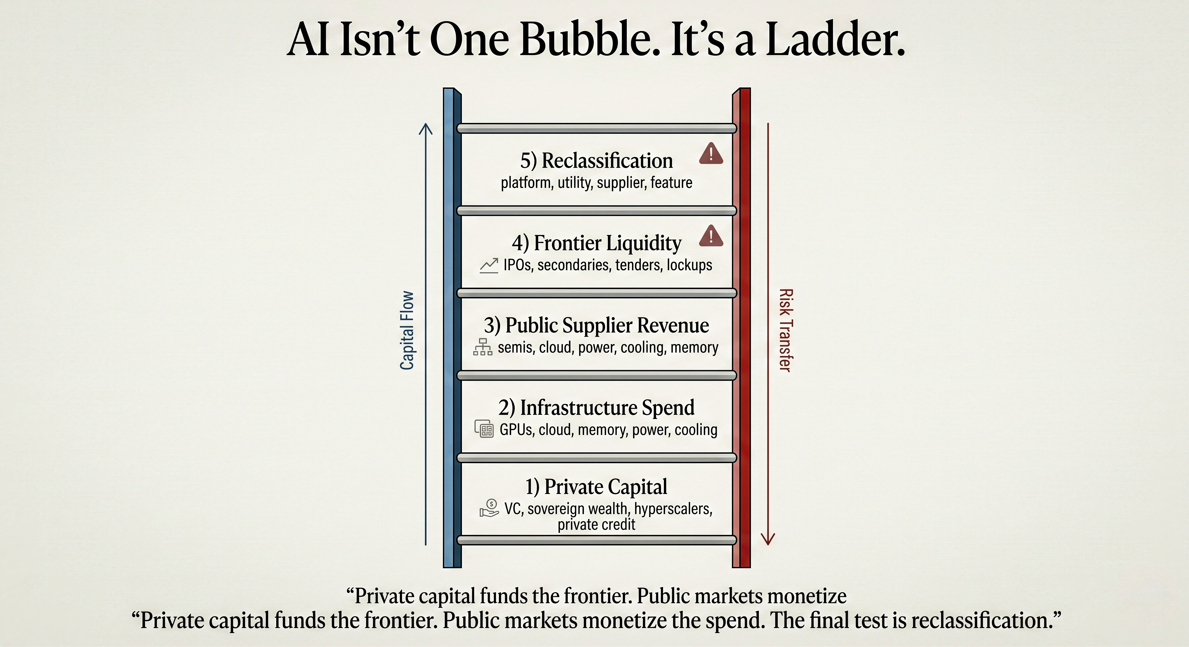
When you map the ecosystem this way, it becomes clear that AI is not one bubble. It is a liquidity ladder.
The Architecture of Risk and Capital
The ladder starts in private markets, where sovereign wealth, venture capital, hyperscalers, and private credit finance the frontier labs. The next rung is spending: that capital is converted into GPUs, cloud contracts, memory, power systems, cooling units, and data centers. The third rung is public earnings, where public companies like NVIDIA, Microsoft, Amazon, Vertiv, Eaton, Schneider, and Micron report the revenue. The fourth rung is liquidity, when the frontier labs themselves eventually seek public liquidity. The final rung is reclassification. Public investors finally have to decide what they bought: a platform, a utility, a supplier, or a feature.
Every liquidity ladder transfers not only capital, but risk. Private investors fund the uncertain phase. Suppliers monetize the buildout. Public capital arrives when the story is clean enough to sell. By then, the question is no longer whether the technology works. It is whether the price already assumes too much of the future.
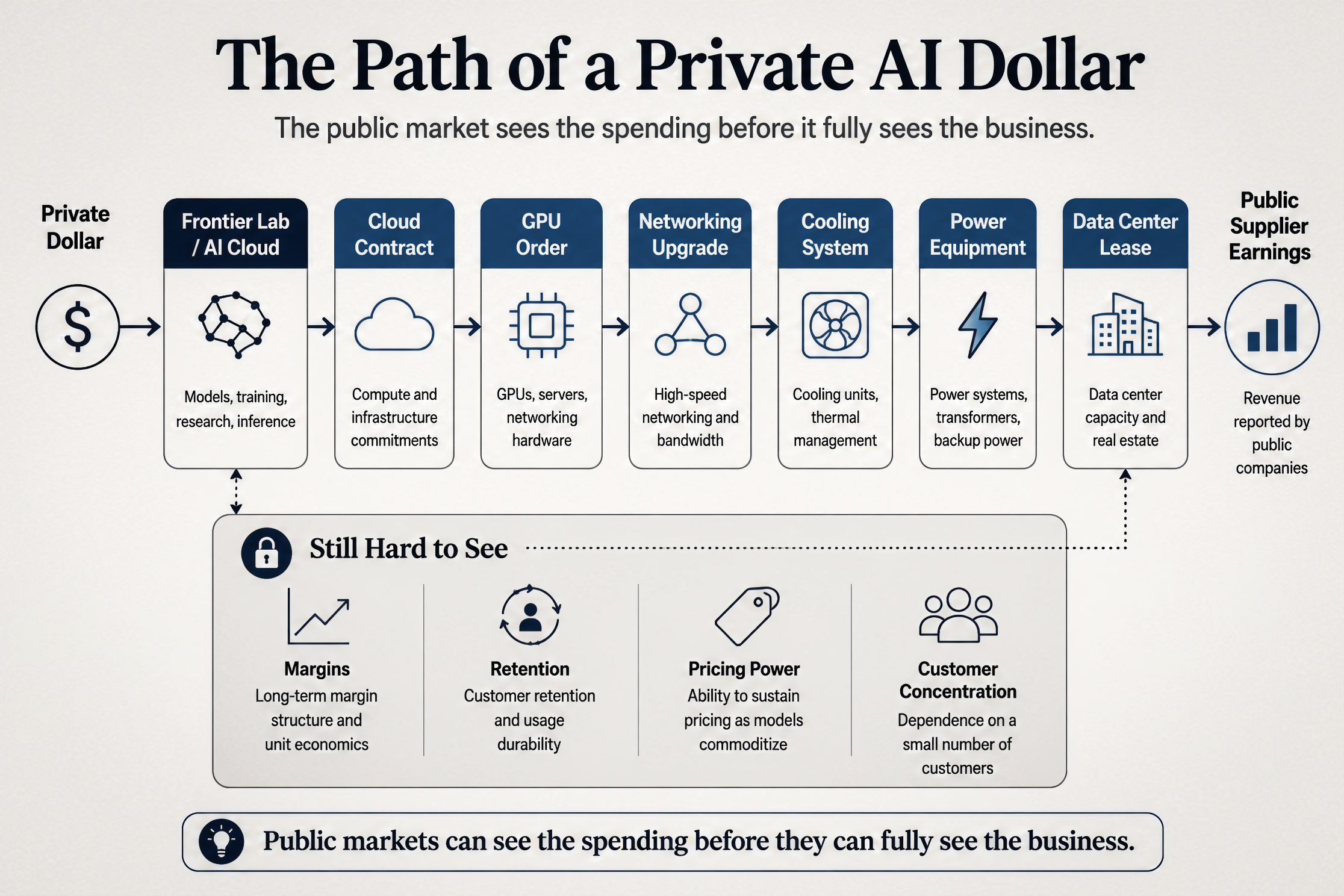
Consider the path of a single private dollar. It enters the system through a frontier lab or AI cloud. It becomes a cloud contract, a GPU order, a networking upgrade, a cooling system, a power-equipment backlog, or a data-center lease. By the time public markets see it, that private dollar has already been converted into revenue for a chain of public suppliers. But the original company that raised the dollar may still be private, with its long-term margins, retention, and pricing power hidden behind the curtain. That is the strange structure of this cycle: equity buyers can see the spending before they can fully see the business.
This distinction changes how every participant should read the market. Founders need to know whether they are building a workflow owner or a model-dependent wrapper. Operators need to know whether AI reduces friction or simply adds another vendor layer. Enterprise buyers need to know which system can be trusted inside the machinery of the business. Investors need to know whether a company owns a scarce bottleneck or merely participates in a popular theme.
The Private Engine and the Public Spillover
The first rung of the ladder is private capital, and it is larger than the public conversation usually acknowledges. The AI boom has not primarily been funded in the open. It has been warehoused privately, where valuations can climb without the daily discipline of public-market disclosure.
OpenAI’s recent private rounds alone reached a scale that would dwarf most conventional technology IPOs, pulling in tens of billions of dollars. Anthropic and xAI have raised so much privately that the IPO no longer looks like the beginning of the story. It looks like a later liquidity event. CoreWeave’s $1.5 billion IPO, one of the first major AI-native public liquidity events, looks small next to the private capital already moving through the system. This disparity does not explain the entire AI cycle, but it shows that the first phase of the boom has been structured privately, even as public markets trade the consequences. The pattern repeats across much of the frontier.
That private capital does not sit idle. It is immediately deployed into physical and digital infrastructure. The boom is not imaginary. The cash register is ringing.
When NVIDIA reported $81.6 billion in quarterly revenue, and when Microsoft, Amazon, and Google highlighted surging cloud demand, they were not selling narrative alone. They were showing how private AI ambition becomes public-market revenue. The industrial manufacturers supplying power and cooling (such as Vertiv, Eaton, and Schneider) are seeing order acceleration driven directly by data center expansion.
That is what makes this cycle harder to dismiss than a pure public-market hallucination. Some of the public winners are not trading only on future possibility; they are already reporting the revenue from the buildout. Public investors are already monetizing the second-order effects of private AI spending. The mistake is assuming that because the spending is real, every valuation built on top of it is durable.
That is where the ladder becomes dangerous. The first three rungs can be solid, and the fourth can still be mispriced.
Defining the Air Pocket
When frontier labs eventually seek public liquidity, the ecosystem will face a critical test. Market participants are conditioned to value dominant technology companies as high-margin software platforms or monopoly toll roads.
IPO windows are dangerous because they simplify messy businesses into clean stories. By the time a company reaches public investors, the pitch has usually been polished into inevitability. That is where the misclassification risk begins.
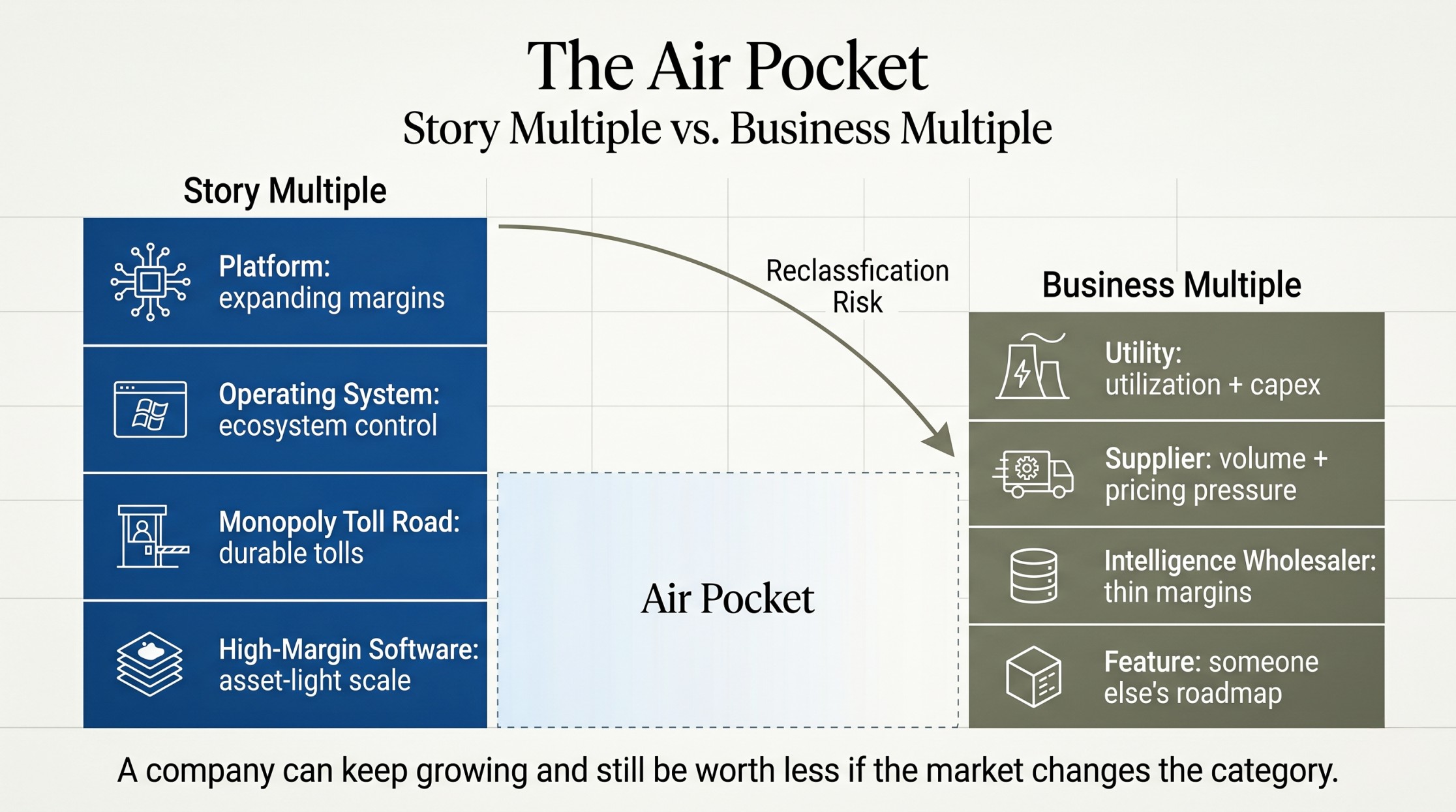
The air pocket is the gap between the story multiple and the business multiple.
Parts of the economics of frontier AI may resemble compute-heavy utilities, intelligence wholesalers, or simple consumer subscription businesses. A platform gets valued on expanding margins, ecosystem control, and high switching costs. A utility gets valued on utilization, financing cost, capacity discipline, and customer concentration. A supplier gets valued on bargaining power. A feature gets valued as someone else’s attach rate. Confuse those categories, and the valuation can change even if the product keeps growing. The risk is not collapse. The risk is reclassification.
CoreWeave is not a frontier model lab, which is precisely why it is useful. It shows how quickly an AI-native story can become a financing, utilization, and capacity-management story once it enters public markets. If the broader market eventually prices an intelligence wholesaler like an invincible operating system, the resulting multiple compression could create the air pocket.
The Enterprise Distribution Problem
The vulnerability of standalone model providers is compounded by the structural realities of enterprise software. Fortune 500 companies do not buy technology the way consumers do.
A bank does not want "a model." It wants auditability. A manufacturer does not want "a chatbot." It wants a system that can touch ERP, inventory, compliance, and service records without creating legal shrapnel. A hospital does not want a clever assistant floating outside its workflow. It wants something that fits inside permissions, patient records, and liability boundaries.
Because of these constraints, many enterprises are likely to consume AI through the vendors they already trust. Menlo research indicates that 76% of enterprise AI use cases are currently purchased rather than built, and more than half of enterprise AI spend is directed to the application layer rather than raw infrastructure. That tilts the field toward incumbents like Microsoft, Salesforce, ServiceNow, SAP, Oracle, and Adobe. Which already control the procurement channels and systems of record.
If the customer experiences AI as a Microsoft workflow, a Salesforce automation, or a ServiceNow agent, then the model provider may be essential without being the primary economic owner. The model may be the brain, but the incumbents may own the body.
The Counterargument: Agents Could Flip the Stack
There is a strong counterargument to this incumbent dominance. If autonomous AI agents become the primary interface for enterprise work, the frontier labs could swiftly move up the technology stack.
If the user no longer opens Salesforce to update a pipeline, Workday to process a headcount request, and ServiceNow to resolve a ticket, but instead delegates the entire chain to an agent, the dashboard loses power. The control point shifts from the application to the orchestration layer.
This is why the agent layer is so strategically important. It is not merely another interface. It is the layer that could decide whether SaaS remains the system of engagement or becomes hidden plumbing.
In that world, AI does not get absorbed into SaaS. AI abstracts SaaS away.
For that to happen, agents must become reliable enough to operate across permissions, systems of record, audit trails, and high-stakes workflows without becoming a compliance nightmare. That is not impossible, but it is much harder than producing an impressive demo.
None of this means frontier labs are doomed. The opposite may be true if they own the agent layer, memory, identity, developer ecosystem, or workflow orchestration. The point is not that they cannot win. The point is that the valuation must assume a battle, not a coronation.
Commoditization: When Miracles Become Utilities
The history of technology is the history of miracles becoming utilities. Email was once miraculous. Search was miraculous. GPS was miraculous.
Consumers normalize miracles quickly. The first time a model writes a useful summary, it feels like magic. The tenth time, it feels like a feature. The hundredth time, it feels like something that should be free.
Enterprises can sustain higher pricing than consumers, but only when intelligence is attached to a governed workflow or measurable business outcome. Raw capability alone is a weak pricing umbrella once multiple models are good enough.
The economic forces pushing toward model commoditization are already visible. Stanford’s AI Index highlights that the cost of querying a GPT-3.5-class model plummeted more than 280-fold between late 2022 and late 2024. Model performance is rapidly converging, with top developers clustered within 25 Elo points at the frontier. Public API pricing already shows the direction of travel: model access is getting cheaper, faster, and harder to differentiate at the low end.
If raw intelligence becomes abundant, the scarce asset is no longer the answer. It is the trusted system that knows when to use the answer, where to send it, and whether anyone should act on it.
Historical Parallels
We do not have to guess what happens when a revolutionary technology arrives exactly on schedule but the capital structure built around it fractures.
Railroads transformed commerce and geography, but the adoption of the technology did not protect investors from overcapitalization. Telecom fiber was necessary for the internet, but the late-1990s buildout still outran monetization. Cisco was selling real hardware into a real future, yet even supplier dominance could not save the stock from a brutal rerating once expectations outran the cash flows investors could rationally underwrite.
The future can arrive on schedule while the capital structure built around it collapses.
Signals to Watch
The air pocket will not announce itself with a headline. It will show up first in the plumbing: API prices falling faster than volume can compensate, enterprise AI attach rates accruing to incumbents, and frontier lab gross margins failing to look like software. Then it will show up in the capital markets: hyperscaler capex revisions, flattening infrastructure backlogs, widening secondary-market discounts, and IPO lockups turning into supply events.
Which Rung Are You Standing On?
The debate over the AI bubble is asking the wrong question.
AI may reshape the economy and still disappoint many AI investors. Those ideas are not contradictory; they are how technology cycles work. The invention survives. The first valuation structure often does not. The market is not irrational for rewarding the companies supplying the infrastructure. But the next test comes when heavily funded frontier companies move from private ambition to public liquidity.
The risk is not that the ladder is fake. The risk is that public markets eventually discover which rung they are actually standing on.